
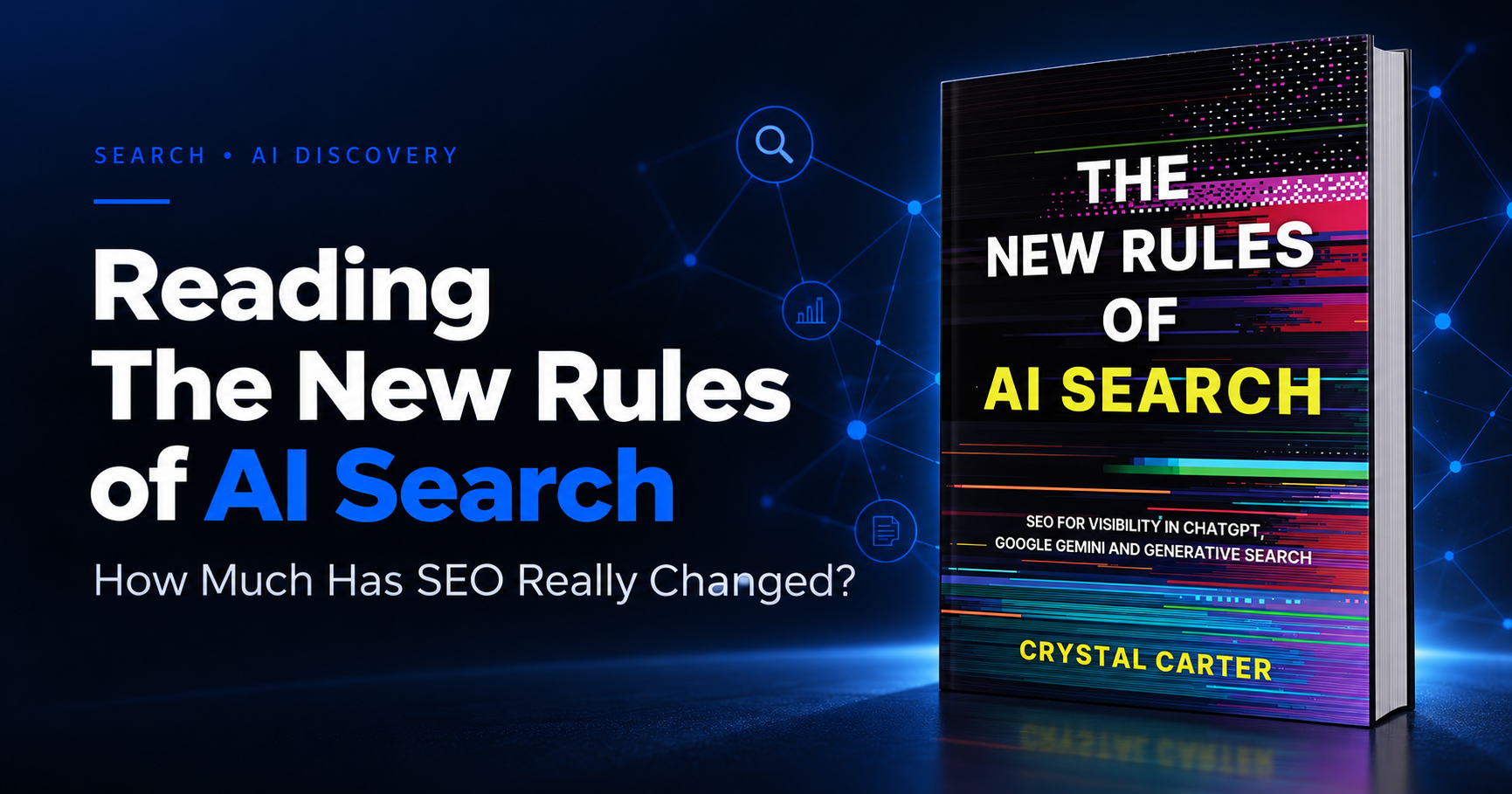
I started reading Crystal Carter’s The New Rules of AI Search on my trip to BrightonSEO in San Diego, and I approached it the same way I tend to approach books like this: slowly, with a lot of notes, and with an eye toward the ideas I wanted to come back to. By the time I made my way through it, I had something closer to a set of course notes than a few highlighted passages.

Before we get into it, I want to clarify from the start that this isn’t a book review. What interests me more is what happened as I made my way through the book. The book is called The New Rules of AI Search, and there are certainly new rules in it. Crystal spends a good amount of time on concepts that did not occupy much space in an SEO strategy a few years ago, such as training data, retrieval-augmented generation (RAG), reasoning models, embeddings, query fan-out, AI crawlers, prompt tracking, agentic experiences, and the different ways information can enter an AI-generated response. The focus is much more on LLMs and conversational search than on Google AI Overviews, which is worth keeping in mind because AI Overviews, AI Mode, and standalone LLMs often get lumped together even though they do not necessarily work the same way or create the same optimization challenges.
The further along I got into the book, though, the more I kept coming back to another question: how much of what we need to do as SEOs has actually changed?

The New Rules of AI Search by Crystal Carter
I’m using Crystal Carter’s The New Rules of AI Search as the starting point for this article, but I’m not attempting to summarize everything in the book. If you want to dig into the frameworks, examples, and tactics yourself, I highly recommend you pick up a copy on Amazon.
AI Search Really Is Different
It would be easy to go too far with the argument that none of this is new. There are meaningful differences between traditional search and AI search, and one of the more useful ideas in the book is the difference between the variety of AI responses.

Crystal categorizes those responses into training-data responses, retrieval-based responses, and reasoning responses. Each type relies on somewhat different information and behaves differently. A training-data response may depend on information already embedded in the model. A retrieval-based response may go looking for fresh information. A reasoning model may break a question into multiple sub-questions, consult different sources or expert pathways, and synthesize a more complex response.
The section on reasoning models was especially interesting to me because it connects directly to query fan-out. A few years ago, before “query fan-out” became the common term, I was writing about a similar concept as “related queries” in my own research on AI Overviews. The terminology has changed, but the underlying idea is familiar: instead of treating a user’s query as one thing, the system may break it into a series of related questions and gather information across those angles before producing an answer. Crystal recommends thinking about content in a similar way by identifying likely subquestions around a topic and building enough depth that your site can help answer more than one part of the larger problem.
That changes how we need to think about the content we publish. You are no longer only asking whether a page ranks for a query. You also have to think about whether individual pieces of information can be understood, retrieved, cited, combined with other sources, and used as evidence inside a larger answer.
That there is a meaningful change, but once you move from the mechanics to the work required to improve your chances of being included, things start to look surprisingly familiar.
A Lot of the Work Still Looks Like Good SEO
As I worked through my notes, the same concepts kept showing up. Know your customer. Make your website crawlable. Create useful content. Organize related topics. Use internal links. Keep important pages up to date. Clearly describe your products or services. Build authority beyond your own website. Earn mentions from credible sources. Manage your reputation. Make it easy to understand who you are and what you do. Measure whether any of this is actually producing business results.
None of those ideas would have looked particularly out of place in an SEO strategy ten years ago.
The RAG optimization section is a good example. There is plenty of AI-specific context around it, but many of the recommendations involve crawl hygiene, internal linking, content freshness, topic clusters, structured data, and identifying pages that already perform well so you can strengthen them further. Even the discussion around reasoning models comes back to creating detailed explainers, answering hard questions, publishing original research, structuring content clearly, and demonstrating expertise.
The destination may be changing, and some of the systems consuming the information are changing, but a lot of the raw material remains familiar. That does not mean AI search optimization is simply traditional SEO under a new name. It means many of the things good SEOs were already trying to accomplish have become useful for reasons that extend beyond ranking in Google.
Your Website Matters, But Your Website Is Not the Whole Story
This may be one of the bigger changes. SEO has always involved signals beyond a website, but AI search makes the broader information environment around a brand harder to ignore.
Throughout the book, Crystal comes back to mentions, review platforms, trade organizations, PR, social media, forums, user-generated content, partnerships, industry sites, and other places where information about a company can exist. You have to make sure the information being repeated about a brand across the relevant web space is accurate, consistent, and useful.
In the chapter on training-data responses, for example, the emphasis is on being mentioned frequently and accurately in credible places, including press, industry organizations, review platforms, collaborations, and other authority hubs. Later, the book expands this further into social media, reviews, Reddit, forums, YouTube, Facebook, and other sources that can contribute to how AI systems interpret a brand or the consensus surrounding it.
By the final chapters, this turns into what Crystal calls the “offsite echo,” where a brand’s positioning, values, and claims may also be discussed, debated, reinforced, or challenged in the communities where its customers spend time.
For years, many businesses have treated their website, social media, reviews, PR, directory listings, and community activity as separate marketing channels. AI systems do not necessarily respect those organizational boundaries. They are trying to understand the entity, and that means the wider digital footprint surrounding a business may become part of the answer.
Entity Clarity May Be the Connective Tissue
This is one area of the book that naturally overlaps with research I have already been doing. Crystal spends time on semantic triples, named entities, relationships, disambiguation, and explicitly defining what a brand is, what it does, who it serves, and what other people, organizations, places, products, and concepts are connected to it.
That may sound technical, but the underlying idea is straightforward. Search systems and AI systems need to understand what something is before they can confidently decide when it belongs in an answer. A business should not force a machine to guess its category, its audience, the difference between it and another similarly named company, or the relationships that help define what it is known for.
This is where I think entity optimization becomes less about schema markup or Knowledge Graph tricks and more about information clarity. Who are you, what do you do, who do you do it for, where do you operate, what are you known for, who or what are you associated with, and what evidence exists to support those associations? Those questions matter whether the system on the other side is a traditional search engine, a knowledge graph, or a large language model.
For more on entities, check out my articles on Search Engine Land, Google’s LLM patent suggests a new goal for SEO: Teaching AI who you are and How to audit your AI entity footprint.
Search Is Becoming More About Evidence
One of the patterns I kept seeing in my notes was a move from thinking about links as authority signals to thinking more broadly about evidence. A mention, a review, or a trade association profile can matter. Let’s go even further. Press articles, forum conversations, case studies, product pages, videos, and original research ALL can matter.
Different response types may use those sources differently, but the direction is toward giving systems enough corroborating information to make a confident recommendation or statement. That is one reason the traditional demarcation between “on-site SEO” and everything else starts to feel less useful.
If an AI system is synthesizing information from multiple sources, your job is not only to make your website say the right thing. You want the relevant web space to provide enough supporting evidence that the claim is believable. That does not make every single mention equally valuable, and it definitely does not mean businesses should spray their name across every site they can find. Credibility, context, and relevance matter a lot.
But the unit of optimization starts to feel less like the webpage itself and more like the entity and the evidence surrounding it.
Measurement May Be Where SEO Changes the Most
The part of the book that may require the biggest adjustment for many marketers is measurement. Traditional SEO reporting has relied heavily on keywords, rankings, impressions, clicks, traffic, and conversions. Those metrics are not going away, but they cannot tell you everything about what is happening inside an AI-generated answer.
Crystal introduces a broader set of measures that include brand mentions, domain citations, third-party citations, sentiment, AI referral traffic, AI bot activity, adoption market share, and AI-influenced conversions. Prompt tracking adds another layer because instead of asking only where you rank, you may also need to ask whether your brand appears at all, how often it appears, which topics trigger it, which sources are being cited, which competitors appear alongside you, what the system says about your business, and whether any of that changes over time.

Crystal also makes an important point about branded prompts. Tracking questions that already contain your company name can create a misleading sense of success. The more useful opportunity is often in non-branded discovery, comparison, and category-level questions where the user has not already decided who they are looking for.
That is a meaningful change in how we think about search performance. It is also probably going to take some experimentation before anyone has the perfect reporting model.
Experimentation Is Part of the Job Now
The book does not present every emerging AI optimization tactic as settled science, which I appreciated. There is an entire chapter devoted solely to experimentation, including things like llms.txt, platform participation, agent experiences, and other techniques that may or may not become significant over time.
That is probably the appropriate mindset for much of AI search right now. Test ideas, measure what happens, see whether systems react, and keep or discard tactics based on what the evidence shows. One of the dangers in a rapidly changing area like AI search is turning every technical possibility into a new best practice before we have enough evidence to justify it.
There is already plenty of that happening. I would rather treat some of these ideas as hypotheses worth testing than commandments everyone needs to implement immediately.
After All of This, We Still Have to Understand the Customer
What I found interesting about the later chapters is that after spending so much time on models, crawlers, retrieval, entities, prompts, and measurement, the book eventually brings the conversation back to something much more basic: you have to know your customer.
The final chapter in my notes focuses on how specific customer attributes, value propositions, community conversations, support questions, and audience programs can influence whether a brand is a strong match for a particular person.
That may ultimately be one of the more important lessons. AI search can become technically complicated very quickly, and we can talk about embeddings, retrieval pipelines, reasoning models, fan-out queries, tokenization, prompt tracking, and agentic systems all day. But the purpose of all that machinery is still to help someone get an answer.
For businesses, the underlying questions come down to…Who is this person? What are they trying to accomplish? What problem are they trying to solve? Why would our business be a good match? What evidence exists to support that conclusion?
So, How Much Has SEO Really Changed?
You know what? I am still working through that question. There are parts of AI search that are unquestionably new. The systems work differently, the user experience is changing, and information can be retrieved, combined, summarized, and presented in ways that traditional search engines could not easily provide. We need to understand those mechanics, and we also need new forms of measurement and a better understanding of how different AI systems discover and use information.
But one of the things The New Rules of AI Search has reinforced for me is that the foundations are not disappearing. We still need to understand the customer, create useful information, make that information easy to access and understand, clearly define who we are and what we do, develop real expertise around the topics we want to be associated with, build relationships and earn credible mentions outside our own websites, maintain a strong reputation, and give search systems enough evidence to confidently connect a business with the right questions.
The technology is changing quickly. I am not convinced the reasons one business gets found, trusted, and chosen over another are changing nearly as fast.
If you are in SEO, learning about AI, AI optimization, LLMs, agents, etc…. I highly, highly, highly recommend you add Crystal’s book to your library.
Leave a Reply