
PERSPECTIVE ON THE FUTURE OF SEARCH
Search Is Moving From Ranking to Understanding
For most of the history of SEO, search has been treated largely as a ranking problem.
That model still exists, but it no longer describes the full discovery process. Search and AI systems increasingly interpret intent, expand queries, retrieve evidence, understand entities, and synthesize information before presenting an answer.
The challenge is no longer simply “How do we rank?” It is “How does a system understand who we are, what we do, who we help, and whether there is enough evidence to include us?”
The Traditional Search Model Was Relatively Linear
For years, search followed a fairly predictable path. A user entered a query, the search engine returned relevant documents, those documents were ranked, and the user decided which result to click.
SEO developed around that process. We researched keywords, optimized pages, earned links, improved technical performance, created content, and measured success through rankings, traffic, clicks, and conversions.
That model still matters. What has changed is that the search system increasingly does more of the interpreting, gathering, comparing, and evaluating before the user ever reaches a website.

Search Is Becoming Less Linear
Modern search increasingly extends beyond the exact query a person enters.
Search engines and AI systems can expand the search into related questions, reformulations, implied needs, and other retrieval paths before constructing a response. That means the information ultimately used in an answer may come from documents that were surfaced somewhere else in the process, not simply from the rankings for the original query.
This matters because visibility is no longer determined by one search result alone. A business may enter the discovery process through multiple paths, while another business may rank well for the original query but never become part of the information the system ultimately retrieves and uses.
The journey is becoming branching, contextual, and dynamic.

Ranking Is Becoming an Input, Not the Finish Line
For years, rankings served as one of the most useful proxies for search visibility. If a page ranked prominently, it was visible. If it did not rank, visibility was much harder to achieve.
AI-powered search complicates that relationship.
A webpage can rank well and still fail to influence an AI-generated answer. At the same time, another source may be retrieved, cited, or incorporated into a response because it entered the system through a different retrieval path.
That is why I increasingly think of ranking as an input rather than the finish line. Search performance still matters because ranking can influence whether information is retrieved, but ranking alone does not tell us whether that information will actually become part of the answer.
The goal is becoming participation in the retrieval process itself.

Search Is Moving From Documents Toward Entities
Traditional SEO has focused heavily on webpages. We optimize documents so search engines can understand what each page is about and determine when that page should appear.
But a business is not a webpage. A brand is not a webpage. A person, product, organization, service provider, or location is an entity represented across many different sources of information.
As search systems become more capable of synthesizing information across the web, they increasingly need to understand the entity behind the content, not just the content itself.
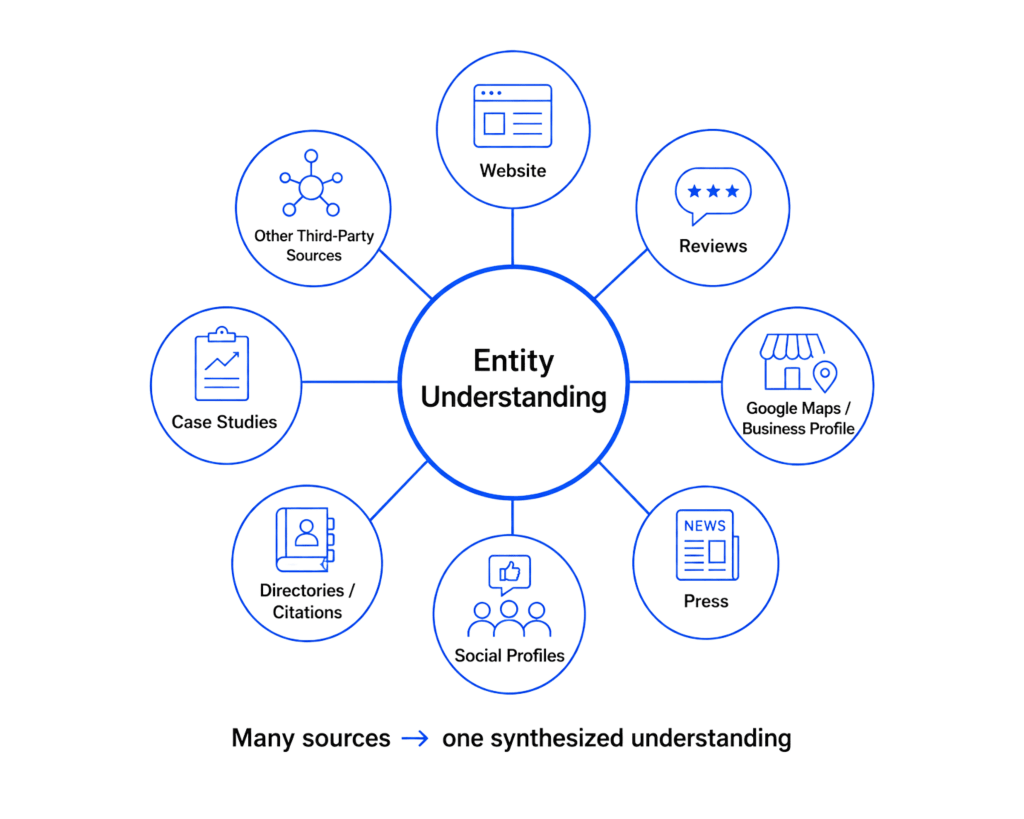
That means a service page, a case study, a team page, customer reviews, press coverage, local listings, social profiles, Maps data, and other references may all contribute different pieces to the system’s understanding of who a business is and what it represents.
The website remains important, but it is increasingly one part of a much larger information environment.
Understanding Requires Evidence
A business can make almost any claim it wants on its own website. It can say it is experienced, trusted, responsive, innovative, or highly regarded.
But search and AI systems increasingly have access to a much wider information environment. Reviews, directories, press coverage, social profiles, citations, community discussions, Maps data, and other third-party sources can reinforce or challenge what a business says about itself.
That broader body of evidence helps systems form a more complete picture of who an entity is, what it does, how it is perceived, and whether the available information is consistent enough to trust.
This is why I increasingly think about visibility as an evidence problem as much as a content problem.
The stronger the evidence surrounding an entity, the easier it becomes for systems to develop confidence in their understanding of it.
Website
Owned information
Reviews
Customer experience
Citations
Independent references
Press
Third-party validation
Directories
Business consistency
Community Mentions
Real-world discussion
Evidence → Confidence → Understanding
Search Is Becoming a Recommendation System
Search has always helped people make decisions, but traditionally it did that by presenting a ranked list of options and leaving most of the evaluation to the user.
AI-powered search systems increasingly take on more of that work. They interpret what someone needs, retrieve information from multiple sources, evaluate the available evidence, compare alternatives, synthesize what they find, and in some cases recommend what the user should consider next.
That changes the role of the search system. It is no longer simply retrieving documents. Increasingly, it is helping narrow the consideration set.
Before a system can confidently recommend a business, product, service, or source, it needs enough information to understand what that entity represents and enough evidence to justify including it.
Recommendation is becoming the outcome of interpretation, retrieval, evidence, and understanding working together.

A Broader Model of Search Visibility
If search is becoming less linear and more dependent on retrieval, evidence, entity understanding, and recommendation, then visibility has to be understood more broadly than rankings alone.
I think a more useful model is to look at the stages a business may need to move through before it can influence a final decision.
Found → Understood → Trusted → Retrieved → Cited → Selected → Chosen
Found
Can the system find information about you?
Understood
Does it understand who you are, what you do, and where you fit?
Trusted
Is there enough evidence to support that understanding?
Retrieved
Does your information enter the retrieval process for the questions that matter?
Cited
Are you or sources about you used as supporting evidence?
Selected
Do you become one of the options the system considers or presents?
Chosen
Does that recommendation ultimately influence a human decision?
Not every search follows these stages in exactly the same way, but the model helps explain why ranking alone is becoming an incomplete measure of visibility.
People Still Make Decisions
No matter how sophisticated search systems become, the end result is still human behavior.
A search engine or AI assistant may determine which businesses enter the consideration set, but people still decide whether those businesses feel credible, relevant, trustworthy, and worth choosing.
That means modern visibility operates at two levels. First, a system has to find enough information and evidence to understand and surface an option. Then the person receiving that recommendation has to decide whether it makes sense for them.
People still read reviews, compare alternatives, evaluate reputation, respond to familiarity, assess risk, and look for signs that a business understands their needs. A machine may narrow the choices, but trust still determines whether someone takes the next step.
The better a search system understands people, the more useful its recommendations can become.

The Goal Is No Longer Just to Rank
Rankings still matter, but they are no longer a complete model for understanding modern search.
Search engines and AI systems are increasingly interpreting intent, expanding queries, retrieving evidence, understanding entities, evaluating alternatives, and shaping recommendations before a person ever reaches a website.
That means businesses need more than visibility. They need a digital presence that helps both people and machines understand who they are, what they do, who they help, and why they deserve to be trusted.
The challenge is no longer simply to rank. It is to be found, understood, trusted, retrieved, cited, selected, and ultimately chosen.
That is the transition I am studying.