
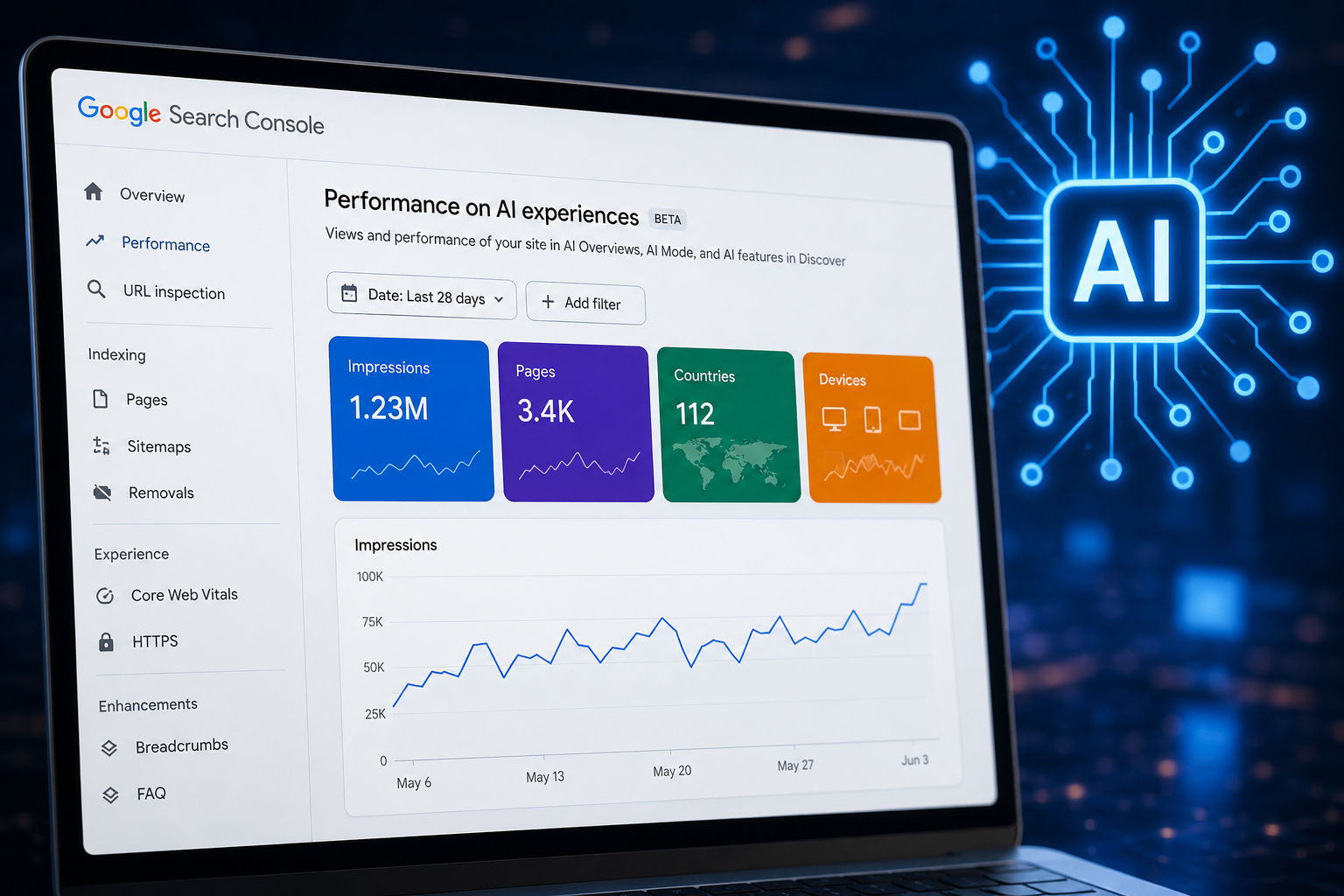

Google has officially announced dedicated reporting for generative AI experiences in Google Search Console. The new reports will provide visibility into how often pages from your site appear in AI-powered search experiences, including AI Overviews, AI Mode, and generative AI features in Discover.
For many SEOs, this announcement is long overdue.
Google is now providing something it previously indicated it had no plans to provide. Over the last two years, one of the biggest frustrations we’ve had surrounding AI Overviews has been the lack of transparency. We knew Google was incorporating website content into AI-generated answers. We knew AI Overviews were changing how search results were presented. What we didn’t know was how often our content appeared in those experiences or what impact that visibility was having.
I’ve written several articles on this topic since Google first introduced the Search Generative Experience (SGE), which eventually became AI Overviews. Looking back at those articles today documents how much Google’s position on AI reporting has evolved. At the same time, many of the questions SEOs, publishers, and website owners have been asking since AI Overviews launched remain unanswered.
Key Takeaways
Google has officially launched dedicated AI reporting in Search Console for AI Overviews, AI Mode, and generative AI features in Discover, giving site owners a dedicated view into AI visibility for the first time.
This represents a significant shift in Google’s position on AI reporting. Less than two years ago, Google indicated there were no plans for AI Overview-specific reporting, arguing that AI Overviews were simply part of Search.
The new reports include impressions, pages, countries, devices, and date-based reporting, helping site owners better understand where and how their content appears in Google’s AI-powered search experiences.
Google is effectively recognizing AI visibility as its own measurement category. Rather than treating AI experiences solely as part of traditional Search, Google is now providing dedicated reporting for generative AI visibility.
Several important data gaps remain. The reports do not currently provide query-level reporting, visibility into query fan-out and retrieval paths, or a breakdown of performance between AI Overviews and AI Mode.
The traffic impact of AI visibility remains unclear. While the new reports improve transparency around appearances and impressions, they do not fully answer whether AI visibility translates into more clicks, engagement, or conversions.
Third-party SEO tools will continue to play an important role. Platforms such as Semrush, Ahrefs, Authoritas, and Advanced Web Ranking still provide query-level insights and competitive analysis that are not currently available in Google’s reports.
This feels like Version 1.0 rather than the final destination. Google has indicated it is gathering feedback and may expand reporting over time, suggesting additional metrics could be added in future updates.
Google’s Position on AI Reporting Has Changed
When Google first introduced SGE in 2023 and expanded testing throughout 2024, one of the biggest unknowns was reporting. At the time, Google had shared very little about how performance data would be measured or surfaced inside Search Console.
In an article I published in January 2024, I noted that Google had not yet shared which metrics would be available for tracking performance in SGE and that we were largely in the dark regarding how these new AI experiences would be reflected in Google Search Console and Google Analytics. There were a lot of open questions. Would AI visibility receive its own reporting? Would impressions and clicks be separated? Would Google provide query-level data? Nobody knew.
Later that year, Danny Sullivan addressed the issue directly during an interview with Aleyda Solis. His answer seemed to close the door on dedicated AI reporting. According to Sullivan, Google viewed AI Overviews as part of Search, similar to Featured Snippets and other search features, and there were no plans to create separate reporting specifically for AI Overviews. Google also pointed to the fact that AI Overviews were evolving rapidly, suggesting that building reporting around a feature that was constantly changing would create challenges from a maintenance and development perspective.
As AI Overviews became more common, many SEOs began building their own measurement frameworks. In early 2025, I published an article outlining how to combine Google Search Console data with platforms such as Semrush, Ahrefs, and Authoritas to estimate AI Overview performance. The process involved identifying queries that triggered AI Overviews, matching them against Search Console performance data, and attempting to measure whether visibility in AI Overviews correlated with changes in clicks, impressions, and engagement. It wasn’t perfect, but it was one of the few options available.
That’s why Google’s announcement represents a significant change on their part. Less than two years after stating there were no plans for dedicated reporting, Google is now launching dedicated reports specifically for generative AI visibility.
What Google Is Providing
According to Google’s announcement, the new reports are designed to help site owners understand how their content appears across Google’s generative AI experiences. The reports will include visibility data for AI Overviews, AI Mode, and generative AI features in Discover.

The initial rollout includes reporting for:
- Impressions
- Pages
- Countries
- Devices
- Dates
Google also confirmed that this information will continue to be included in overall Search Console reporting while simultaneously being available through dedicated AI reporting views. Initially, the reports are being rolled out to a limited set of websites while Google collects feedback and continues testing.
For many site owners, impression reporting may end up being the most valuable addition. Until now, there has been no reliable first-party way to understand how often content appeared within Google’s AI experiences. Third-party platforms could estimate visibility based on tracked keywords, but they never had access to the complete picture that Google possesses internally. The ability to directly measure AI visibility using Google’s own data should provide a much clearer understanding of how frequently content is being surfaced within AI-powered search experiences.
Why This Matters
Since their introduction, Google has treated AI Overview visibility as part of traditional Search reporting. The company’s position was that AI Overviews were just another search feature and didn’t require separate reporting. By introducing dedicated AI reports, Google is effectively acknowledging that generative AI visibility deserves its own reporting framework.
Search visibility is no longer limited to ten blue links. Today, visibility happens across a growing collection of search experiences, including traditional organic search, AI Overviews, AI Mode, Discover, local search experiences, agents, and other AI-powered interfaces that continue to emerge. As these experiences become more prominent, businesses and website owners increasingly want to know how they are performing within each environment.
One of the questions I’ve heard repeatedly from clients, marketers, and business owners over the last year is:
“How are we doing in AI search?”
Until now, the answer typically involved a combination of estimates, screenshots, third-party tools, and a fair amount of guesswork. Google’s new reports won’t answer every question, but they provide the first meaningful first-party visibility into AI performance.
The announcement also reduces some of the reliance on third-party estimation. Platforms such as Semrush, Ahrefs, Authoritas, Advanced Web Ranking, and others will continue to play an important role, but Google is now providing direct visibility data from the source itself.
What Google Still Isn’t Telling Us
While this announcement is a significant step forward, it doesn’t answer every question. In some ways, it creates new ones. The new reports provide valuable visibility into how often content appears in AI-powered search experiences, but several important gaps remain.
Query-Level Reporting Is Still Missing
The most obvious omission is query-level reporting. Google’s announcement discusses impressions, pages, countries, devices, and dates, but it makes no mention of queries. For many SEOs, queries are where optimization opportunities begin. Knowing that a page appeared in AI experiences is useful. Understanding which searches triggered that visibility can be far more valuable.
Without query-level reporting, we still cannot easily answer questions such as:
- Which searches generated AI visibility?
- Which topics are appearing most frequently?
- Which search intents perform best within AI experiences?
- How does AI visibility vary across different query categories?
AI Overviews, AI Mode, and Agents Are Grouped Together
Another major gap is the lack of visibility into where AI visibility actually occurred. Google’s announcement groups together multiple generative AI experiences, including AI Overviews, AI Mode, and other AI-powered experiences.
At least initially, it appears that site owners may not be able to distinguish whether visibility came from AI Overviews, AI Mode, or future agent-driven experiences. Those environments can behave very differently, and understanding where visibility occurs could influence content, optimization, and measurement strategies.
Query Fan-Out Remains a Black Box
The announcement also does not provide insight into query fan-out, one of the most interesting topics in AI search today. Over the last year, Google has discussed how AI systems may expand searches, retrieve information using related queries, and use multiple retrieval paths when generating answers.
My own research with Authoritas found evidence suggesting that AI Overviews frequently rely on related and expanded queries when selecting sources. Yet the new reports still don’t reveal anything about that retrieval process.
Questions that remain unanswered include:
- Did the URL appear because it matched the user’s original query?
- Was the URL surfaced through query fan-out or related retrieval queries?
- Which expanded or supporting queries contributed to source selection?
- How much influence do related searches have on visibility?
We can now see the outcome, but we still have very limited visibility into how Google arrived there.
The Traffic Question Remains
Finally, the question many publishers care most about remains largely unresolved: traffic. One of the biggest concerns surrounding AI Overviews has been whether they reduce clicks by satisfying user needs directly within Google’s search results. While the new reports provide greater transparency around visibility, they do not appear to provide a clear answer regarding traffic impact.
Visibility is important, but publishers, businesses, and content creators ultimately care about:
- Visitors
- Engagement
- Leads
- Sales
- Conversions
The new reports help answer where, in general, content appeared. They do not fully answer whether that visibility translated into meaningful business outcomes.
Google has indicated that it may expand these reports over time, so this may simply be the first version rather than the final destination. Still, the absence of query-level, retrieval-level, and traffic-focused reporting will likely leave many publishers wanting more.
What This Means for SEOs
Separate AI visibility from traditional search visibility. For the first time, Google’s own reporting allows you to measure AI visibility independently from overall Search performance. Start monitoring AI impressions as their own category rather than treating them as part of broader organic reporting.
Look for trends, not just visibility. Compare AI visibility against changes in organic impressions, clicks, CTR, conversions, and engagement metrics to better understand whether AI exposure is helping or hurting overall performance.
Continue using third-party SEO tools. Platforms like Semrush, Ahrefs, Authoritas, and Advanced Web Ranking still provide valuable capabilities that Google’s reports currently do not, including query-level tracking, competitor visibility, and AI Overview monitoring.
Treat this as a new measurement layer, not a new SEO strategy. The introduction of AI reporting does not fundamentally change SEO best practices. Continue focusing on creating useful content, building authority, and maintaining strong technical SEO foundations.
Expect the reporting to evolve. Google has indicated that additional metrics may be added over time. Consider the current reports a starting point rather than a complete picture of AI search performance.
Final Thoughts
Google’s new AI reporting is one of the most significant Search Console updates since AI Overviews launched. More importantly, it represents a notable shift in Google’s position.
Two years ago, dedicated AI reporting appeared unlikely. Today, Google is launching dedicated AI reporting and actively asking for feedback about how those reports should evolve. That alone is a meaningful change.
At the same time, many of the questions that matter most to SEOs and publishers remain unresolved. We still don’t know which queries drive visibility, how query fan-out influences source selection, or whether AI visibility consistently translates into meaningful traffic and engagement. For now, this feels less like the final version of AI reporting and more like Version 1.0.
The good news is that Google appears willing to continue evolving these reports. After two years of requests for greater transparency around AI search, that’s a meaningful step in the right direction.
References
Google Search Central. (2026, June 3). Introducing Search Generative AI performance reports in Search Console. Google Developers. https://developers.google.com/search/blog/2026/06/search-console-generative-ai-reports
Sanger, R. (2024, January 9). Google Search Generative Experience: The next big change in search. Rich Sanger SEO. https://richsanger.com/preparing-for-googles-ai-driven-search-generative-experience/
Sanger, R. (2024, September 15). Google antitrust investigation: Impact on SEOs and AI Overviews. Rich Sanger SEO. https://richsanger.com/google-antitrust-investigation-impact-on-seos-and-ai-overviews/
Sanger, R. (2024, October 7). AI Overviews: Google’s Danny Sullivan provides an inside look. Rich Sanger SEO. https://richsanger.com/ai-overviews-googles-danny-sullivan-provides-an-inside-look/
Sanger, R. (2025, January 20). Measuring the impact of Google AI Overviews on SEO performance. Rich Sanger SEO. https://richsanger.com/measuring-the-impact-of-google-ai-overviews-on-seo-performance/