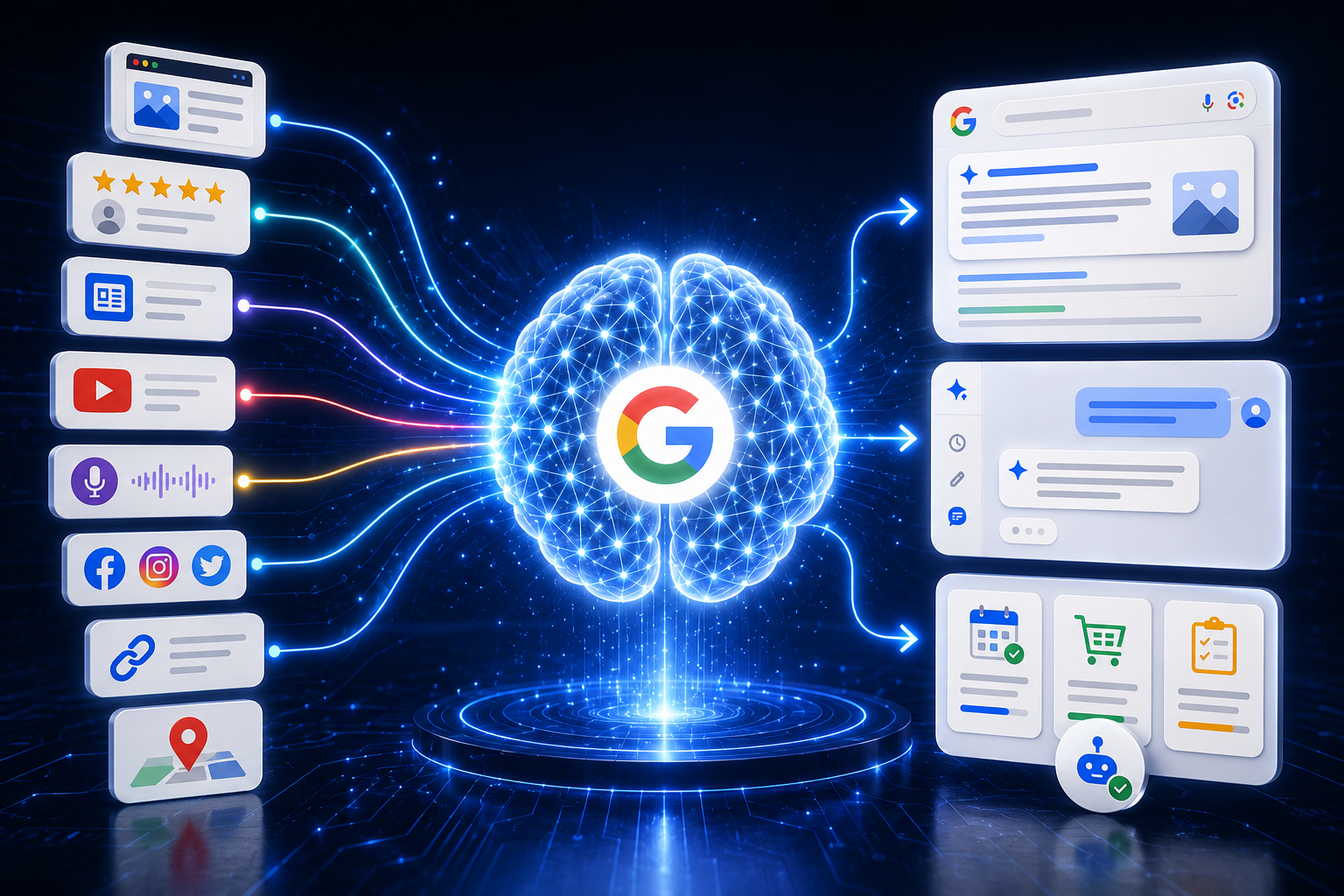
At Google I/O 2026, Google made something very clear: Search is no longer just a search engine with AI features layered on top. Instead, it is becoming an AI-powered system designed to understand complex questions, maintain context, perform tasks on a user’s behalf, and even build custom tools directly within Search.

Liz Reid, Google’s Head of Search, summed it up with a statement that may end up being the defining quote from the event:
“Google Search isn’t just search with AI features. It is AI search, through and through.”
That line stood out to me because it captures how dramatically Google is reframing Search. For years, Google Search has primarily been a retrieval system. You entered a query, Google returned a set of ranked documents, and you clicked through to the websites that appeared most relevant. Both Google and website owners benefited from this reciprocity.
What Google presented at I/O suggests that this model is changing in a much more fundamental way. Search is becoming a system that can understand your situation, synthesize information from multiple sources, and increasingly help you complete tasks directly within Google itself. This isn’t good news for website owners depending on the traffic coming in from Google.
For SEOs, publishers, and business owners, that raises some important questions. What happens to website traffic when Google can answer questions and complete actions without sending users elsewhere? How will Google Search Console report these more complex and personal queries? And if Google continues relying on content from websites to power these experiences, what does the exchange of value look like going forward?
Key Insights from Google I/O 2026
Google Search Is Becoming an AI Agent: Search is evolving from a retrieval engine into an AI-powered system that can understand complex questions, maintain context, complete tasks, and build custom tools directly within Google Search.
This Shift Has Been Underway for Some Time: Many of the concepts highlighted at Google I/O, including related queries, personalization, and AI-generated summaries, were already described in Google’s AI Overview patent.
Search Is Becoming More Conversational and Personal: Users are increasingly entering detailed prompts that provide much richer context about their situation and intent.
Search Console May Become Harder to Interpret: As Google expands queries and users share more personal information, Search Console may provide less exact query data and more topic-level insights.
Website Traffic May Continue to Decline: If Google can answer questions and complete tasks directly in Search, there will be fewer reasons for users to visit websites.
Google Still Depends on the Open Web: Websites, reviews, structured data, and third-party mentions remain essential inputs that help Google understand businesses and topics.
Your Content May Influence Responses Without Earning a Click: A page can help shape an AI-generated answer even if it is not cited or visited directly.
Websites Still Matter: Your website remains one of the most important sources Google uses to understand what you do, who you serve, and why customers should trust you.
A Strong Digital Footprint Matters More Than Ever: Digital PR, content promotion, reviews, and mentions across the web help reinforce Google’s understanding of your brand.
The Value Exchange Is Changing: Google still relies on content from the web, but publishers and businesses may receive less traffic in return.
SEO Still Matters: Useful content, technical accessibility, trust, and a strong overall online presence remain the foundation for visibility in both traditional and AI-driven search.
This Did Not Start at Google I/O
Although Google I/O 2026 offered the clearest articulation yet of where Search is heading, the underlying technology has been evolving for some time. In my 2024 article, How Does Google AI Overview Work? Insights From the Patent, I broke down Google’s patent for “Generative summaries for search results.” What stood out to me at the time was that Google was already building systems capable of doing much more than retrieving documents that matched a keyword.
The patent described a process in which Google could interpret the intent behind a query, expand to related, recent, and implied queries, retrieve content from multiple sources, and generate a summary tailored to the user’s specific needs. In other words, many of the capabilities highlighted at I/O were already there in its infancy. We saw a very similar mechanism in the patent for Google’s AI Mode.
At Google I/O, Google made explicit that these AI capabilities are no longer experimental or separate features. They are now going to be the foundation of Search itself.
Search Is Becoming Conversational, Personal, and Agentic

One of the repeated themes throughout the keynote was that people are searching in longer, more detailed, and more personal ways. Instead of typing a short phrase like “divorce lawyer Boston,” a user might now ask (a bit exaggerated for effect):
“My name is Sarah. I live in Waltham, Massachusetts. My husband told me last week that he wants a divorce. We have two children, ages 7 and 10. I work part-time, and most of our savings are in his retirement account. I’m worried about custody and whether I’ll be able to stay in our home. What should I do first?”
That is not just a longer search query. It is a real-life situation presented to Google in natural language.
Google also introduced agentic capabilities that allow Search to work in the background on behalf of users. It can monitor information over time, send updates, create custom dashboards, and help complete tasks. What stood out to me is how similar this is to what Google has already begun doing in other products.

In my recent article on Google’s Ask Maps and Immersive Navigation, I noted that Google Maps is becoming increasingly conversational. Instead of typing “plumber near me,” users can ask nuanced questions about who can solve a specific problem and Google attempts to recommend the best fit.
What Google announced at I/O is that this same approach is expanding across all of Search. Google is moving beyond keyword matching toward understanding the full context behind a user’s question. And even helping them better shape and define it.
Google Search Is Becoming a Destination, Not Just a Gateway
For most of its history, Google Search has served as a gateway to the web. Google helped users discover information, but the websites themselves were where people went to read, compare, and take action. That relationship is changing, for better or worse.
The new Search experience can generate answers, build planners and dashboards, compare options, monitor information over time, and even complete transactions. In many cases, users may get what they need without ever leaving Google. This is significant because it changes Search from a discovery engine into a destination where users can increasingly find, understand, and act on information in one place.
What Happens to Google Search Console?
One of the questions I kept coming back to while watching Google I/O was what all of this means for Google Search Console. If users are entering highly detailed and deeply personal prompts, how will those searches be reported to site owners?
- Will Search Console show the full query?
- Will Google condense it into a broader topic?
- Will some of the data be withheld entirely because it contains sensitive information?
This becomes even more interesting when you consider query fan-out. In my patent analysis, I explained how Google may take a single query and expand it into related, recent, and implied queries in order to build a better response. If Google is using multiple related queries behind the scenes, will we ever get to the point where the fan out queries are reported in Search Console or will it always be just the original query?
As search becomes more conversational and personalized, the data available in Search Console may become increasingly abstract. We may see more hidden queries, more fragmentation in long-tail search terms, and a greater need to focus on page- and topic-level performance rather than exact-match keywords.
In practical terms, the core question may change from “What keyword did we rank for?” to “What situations is Google trusting us to help with?”
Website Traffic May Continue to Decline
If Google can answer questions, build tools, compare options, and complete transactions directly within Search, there are fewer reasons for users to click through to websites. That DOES NOT mean websites become less important. It does mean, however, that traffic may no longer be the primary reward for publishing content.
One of the more interesting findings from Google’s AI Overview patent was that the documents used to help generate an answer are not necessarily the same documents that appear as citations in the final response. In other words, your content may contribute to Google’s understanding of a topic even if your site is never linked or visited. On the other end, your site might not be the source Google pulled from but, becase of how it is used in the summary, it uses your site as the source.
That possibility becomes much more significant as Google continues moving toward AI-generated and action-oriented search experiences.
Google Still Depends on the Open Web
Having said all that, Google still 100% depends heavily on the open web. During the keynote, Google noted that its information agents help users discover relevant content from “websites and creators.”
In both my Ask Maps analysis and my AI Overview patent article, I highlighted the wide range of signals Google uses to understand businesses and content, including website copy, reviews, structured data, Google Business Profile information, product feeds, news coverage, and other online mentions.
The interface may be changing, but Google still needs reliable information sources to understand the world and generate useful responses.
The Reciprocity Problem

For decades, the relationship between Google and publishers followed a relatively straightforward exchange. Publishers created content. Google indexed that content. Google sent visitors back to the publisher. That traffic provided the incentive for businesses and publishers to continue investing in websites and content. Now, AI search seriously complicates that relationship.
Google still benefits from the content, but the amount of traffic returned to publishers may continue to decline. The web remains the source of the raw material, while Google increasingly becomes the place where users consume and act on that information.
That raises an important question for publishers and businesses alike. Will the value of being cited, referenced, and understood by Google be enough to offset a continued reduction in direct traffic?
Why Websites Still Matter
Even if fewer users click through from Search, websites remain foundational. In my Ask Maps article, I made the point that businesses need to think less about whether they rank for a specific keyword and more about whether Google has enough information to confidently recommend them. That same principle applies here.
Your website remains one of the most important sources Google uses to understand what you do, who you serve, where you operate, and why customers should trust you. In many ways, your website is becoming a structured and authoritative source of information that feeds Google’s broader understanding of your business. That role is every bit as important as it has always been, even if the traffic patterns look different.
Your Digital Footprint Matters More Than Ever
If there is one takeaway I want businesses and publishers to have, it is that your website is only one part of the information ecosystem Google uses to understand who you are and whether you should be recommended. Google’s AI systems need inputs. They need content, reviews, business information, mentions, and other signals that help them build confidence in what your website and/or business does and why it should be trusted.

That is where digital PR, content promotion, and broader brand visibility come in to play. A mention in an industry publication, a detailed customer review, a local news story, a YouTube video, a podcast appearance, or even consistent business information across relevant directories all help reinforce Google’s understanding of your business.
This is one reason I believe SEO is continuing to converge with disciplines like public relations, content marketing, and reputation management. The more high-quality information that exists about your business across the web, the easier it becomes for Google and other AI systems to understand and reference you.
At the same time, it is important to recognize that increased visibility does not necessarily mean increased traffic. Your content may influence an AI-generated response. Your business may be cited in an answer. Your information may help Google recommend you to a potential customer. But the user may never click through to your website. But they might interact with your business in other ways. Attribution here gets a lot more difficult.
That does not mean the effort is wasted. It means the role of your digital presence is evolving. Instead of thinking only in terms of website visits, businesses may need to think more broadly about how their online footprint contributes to discovery, credibility, and conversions across a range of search and AI-driven experiences. In that sense, the goal is no longer just to drive traffic to your website. It is to build a strong enough digital presence that Google understands your business, trusts your information, and confidently surfaces you when it matters most.
What This Means for SEO
The core principles of SEO still matter. In Google’s recent Search Central guidance on optimizing for AI features in Search, which I covered in my article, Google’s New Guidance on AI Search: SEO, Query Fan-Out, and What Still Matters, they made it clear, from their perspective, that ranking in AI Overviews and AI Mode is still fundamentally SEO. Google’s advice was not to adopt an entirely new set of tactics, but to continue focusing on the same things that have long mattered such as creating genuinely useful content, maintaining a technically sound website, and demonstrating trust and expertise.
What may change is how success is measured. SEO may become less about maximizing clicks from traditional search results and more about ensuring that Google understands your content well enough to use it across a growing range of AI-driven experiences. In that AI-driven environment, the businesses and publishers that provide clear, accurate, and trustworthy information are likely to remain the ones Google relies on most.
Actionable Recommendations for SEOs, Publishers, and Business Owners
While Google’s search experience is changing rapidly, the practical response is not to abandon the fundamentals. In many ways, the businesses and publishers that are already doing the right things are the ones best positioned for this next phase of search.
Continue Investing in Your Website
Your website remains one of the most important sources Google uses to understand your business, products, services, and expertise. Make sure your core pages are accurate, comprehensive, and clearly explain what you do and who you serve.
Expand Your Content Beyond Exact-Match Keywords
As Google increasingly interprets intent and expands to related queries, content should address the broader questions and concerns users are likely to have, not just the primary keyword.
Strengthen Your Digital Footprint
Reviews, media mentions, industry citations, social content, and third-party references all help reinforce Google’s understanding of your brand and increase its confidence in recommending you.
Focus on Visibility, Not Just Traffic
Organic traffic may continue to decline, but visibility still matters. Track leads, phone calls, branded searches, and conversions alongside traditional traffic metrics.
Build Content Worth Referencing
Original insights, first-hand experience, research, and unique perspectives are more likely to be used by Google and other AI systems than generic content that simply summarizes what already exists.
Monitor How Search Console Evolves
As search becomes more conversational, query data may become less precise. Pay closer attention to page-level performance, topic trends, and overall business outcomes.
Think Like a Trusted Source
The core question is no longer just whether you rank for a keyword. It is whether Google has enough confidence in your content and brand to use you as a source.
My Biggest Takeaway
Google Search is evolving into an intelligent intermediary. It still depends on the open web to understand the world, but it is increasingly handling more of the discovery, synthesis, and action directly within Google. For businesses and publishers, the challenge is no longer just to attract traffic. It is to become a trusted source that Google chooses to use.
The open question is whether that trust will continue to deliver enough value to sustain the websites and creators supplying the information. That may be one of the most important questions facing SEO and digital publishing over the next several years.